Thursday, August 06, 2020

Operation Infektion

The U.S. certainly has its differences based on gender, race, political preferences and other matters. But is the growing level of anger natural, or is it being encouraged by an outside force? According to some researchers, our internal divisions are being intensified by Russian disinformation experts, and have been doing so since the days of the Soviet Union. PBS News Hour reports.

Questions...

•Why would the Soviet Union and later Russia want to create division, distrust and confusion in the United States?
•What are some of the hoaxes created by the Soviet Union and later Russia? How did they create these hoaxes?
•What makes the U.S. among the nations more vulnerable to this sort of manipulation?

Labels: , , , , ,

Thursday, May 28, 2020

Check This!

Despite not having staff writers or an editorial page, Twitter often finds itself at the middle of some whopping free speech arguments. In April, it tried to crack down on false or misleading information about the Coronavirus by fact-checking dubious posts. And recently, it has fact-checked dubious claims in Tweets made by President Trump. Mr. Trump has reacted in characteristic fashion. NPR reports.

Questions...

•What exactly did Twitter do in response to Mr. Trump's Tweet about voting by mail?

•What has Mr. Trump vowed to do in response to Twitter's action?

•What is a larger reason why Twitter has acted now, in May 2020?

Labels: , , , , , , ,

Tuesday, May 26, 2020

Trump and Biden Online

In six months, the presidential election will be over. Until then, expect and unusually harsh campaign. President Trump and presumptive Democratic Party nominee Joe Biden have very different styles: one is brash and polarizing, the other is genial consensus-builder. It turns out their online campaigns are very different as well. NPR reports.

Questions...

•What is the difference in approaches between the Biden and Tump online campaigns?

•How is the role of mainstream news media different in the two campaigns?

•What is the difference in approach in regard to reaching voters across the political spectrum?

Labels: , , , , , , , ,

Monday, May 04, 2020

Hate and the Coronavirus

These are strange, unsettling, relatively unstable times. Children and teens aren't in school, or even at the playground. They're at home in front of a computer, where they can be exposed to extreme ideas. NPR reports about how White supremacist and other hate groups are using the current Covid crisis to present their ideas to young people.

Questions...

•Why are kids and teens "a captive audience"?

•What forms of hate are being presented?

•What can parents (or older brothers or sisters) do?

Labels: , , ,

Monday, April 20, 2020

Beware of Fabricated Video

We are rightly concerned about polluted air and water. But what about our polluted information environment? Claire Wardle is the co-founder and director of First Draft, a non-profit focused on research about misinformation. NPR summarized her TED talk with a Six Minute Listen.

Questions...

•According to Claire Wardle, what is a common feature of some of the most effective disinformation?

•What has led to the rise of misinformation?

•What damage was done by a fabricated video that claimed Pakistan's polio vaccination program harmed children?

Labels: , , ,

Tuesday, March 10, 2020

The Times Are a Changin'

The following is a MediaNote Classic. It was originally presented to MC101 classes in June 2018.

This is a tough time to own a major daily newspaper. The Los Angeles Times--largely due to poor management under its previous owner--has suffered more than most. With a new owner and a new 21st Century newsroom, the Times is ready to reinvent itself. NPR reports.

Questions...

•What should a newspaper do, whether on paper or online? (what is its function)

•What things about a major metro paper (like the Times) should not be changed?

•What things SHOULD be changed?

•What insights might an immigrant to Southern California have that a native might not have?

•How can the Times be more relevant to young adults like you?

Labels: , , , , , ,

Wednesday, February 19, 2020

Fake News (Thank Goodness!)

This is a MediaNote Classic. It was originally presented to MC101 students in January 2019.

On the night of Feb. 25, 1942, the Los Angeles Area was under attack from enemy aircraft. Or was it? A little more than 10 weeks after the bombing of Pearl Harbor, and several days after a Japanese submarine shelled an oil field just north of Santa Barbara, an unidentified object floated over Los Angeles. Citizens panicked. Civil defense mobilized. Anti-aircraft guns were fired. And CBS radio reported on a possible attack. In the years since, it has become clear that if there was anything in the skies over Los Angeles that night, it was perhaps an errant weather balloon or small blimp.

Questions...

•How well or badly did CBS radio do in reporting this story?

•Why did radio news have a more difficult time covering this story accurately than the newspapers?

•Would today's social media make sure the story was reported accurately, or would it have added to the hysteria?

Labels: , , , , ,

Tuesday, January 07, 2020

F for Fake

Near the end of his legendary filmmaking career, Orson Welles made a movie titled "F for Fake." It was about several instances of fraud that were so convincing that it was hard to tell what was real and what wasn't. It was a very confusing movie. Today, deep fake technology may make figuring out what is real harder than even Welles might have imagined. And what impact could that have on our upcoming elections? NPR reports...

Questions...

•Have you ever seen a deep fake video? What was it?

•Describe a Deep Fake that could cause Mr. Trump or Sen. Warren or some other top political figure to lose votes?

•What Deep Fake could make the divisions between men and women, gays and straights, whites and people of color worse?

•What can average people like us do to make sure (or be as sure as possible) that something is true?

Labels: , , , , , , ,

Monday, December 02, 2019

Get Real

The following is a MediaNote Classic. It was originally presented to MC101 students in November 2018.

In Fall 2019, this MediaNote was presented only to MW classes.

Apparently, Italian youth have some of the same problems telling the difference between factual news reports and fiction that American students have. So the Italian government (public education is more centralized there) has added How to Spot Fake News to the curriculum. NPR reports.

Questions...

•Should government offer training in how to spot fake news?

•Should school districts like Los Angeles and Glendale Unified (or GCC) offer training in how to spot fake news?

•Should social media companies do something about fake news? What should they do?

Labels: , , , , , ,

Thursday, November 14, 2019

"Enemy of the American People"

The following is a MediaNote Classic. It was first presented to MC101 students in March 2017.

Perhaps the single most startling statement of President Trump's short time in office is his proclamation that the media is the "enemy of the American people." While it is true that there have been a huge number of negative stories about Mr. Trump in the media, it is also true that the news media has always taken on an adversarial role toward the President. But the question is, is that adversarial role good for America? Two past Presidents--one a Democrat, the other a Republican--talk about the need for a news media that is free to criticize anyone, especially the President.

Questions...

•What set of rules would you create for the White House Press Corps, no matter who is in office?

•What do you wish the American news media did better? What is the American news media good at?

•What are appropriate ways for the President to respond to news stories he feels are untrue or unfair?

•How do you feel about the President's Twitter account?

Labels: , , , , , , , , ,

Thursday, February 28, 2019

Busy News Day

These are big times in the news business. Mr. Trump's former personal attorney has recently given open Congressional testimony in which he has called the President a racist, a liar and a cheat. Meantime, nuclear arms talks with North Korea have suddenly ended. Pakistan and India--both nuclear-armed nations--are once again uncomfortably close to war. And migrant children continue to be separated from their families. We will take a look at the front page of the Los Angeles Times to see how they are covering this busy news day.

Questions...

•What do you think of the stories on the front page? Do you think the editors judged the day's top stories correctly? What would you change?

•The class can read either the Sheriff story or the Trump/Senate story. Do you feel The Times' coverage of the story is fair to all parties? What would you change?

•Is the Trump/Senate story sort of story that Mr. Trump will call "fake news"? What do you think of that claim?

•The Critical-Cultural Theory states that media consumers use media messages to construct their own world view. What would a Trump or Sheriff Department supporter take out of this coverage to support his ongoing views? What would a Trump or Sheriff Department opponent take out of it? What do you think the undecided reader will take out of this coverage?

•How can the Los Angeles Times or other major new outlet cover a complex news story more credibly or effectively than a blogger than a small following?

•You are a candidate in the upcoming L.A. Unified school board election and you have found out that your opponent is a gun enthusiast who wants to arm classroom teachers. You want to make this revelation public. Are you likely to get more coverage or less coverage for this story in the Monday paper? Why?

Labels: , , , , , ,

Thursday, March 22, 2018

Is It Fun To Be Fake?

The human imagination can construct a seemingly limitless range of outrageous, hilarious, maddening or depressing thoughts. Real life, however, is bound by the dullness of reality.

On Twitter, a lot of true things are reported. But, according to a major academic study, it's the fake stuff that is more likely to be shared and spread. NPR reports.

Questions...

•What makes a good rumor, or good gossip?

•What are some of the best (or worst) fake news stories that you have seen?

•Why do you think false stories are more likely to be spread?

•Do you blame Twitter and other social media companies for the rise of false news?

•What should Twitter and other social media companies do about false news? What can we do about it?

Labels: , , , ,

Thursday, February 22, 2018

Russian to Anger

There are obvious deep and angry divisions in American Society. Your Uncle Fred wants to put Hillary Clinton in prison. A coworker thinks anyone who eats a hamburger is an accessory to murder. Your neighbor is deeply suspicious of immigrants.

But where do these extreme attitudes come from? Does the decline of the "Gatekeepers" (this term will be explained) have anything to do with this? And is there a systematic campaign by the Russians (or others) to support extreme ideas designed to destabilize American society? NPR reports.

Questions...

•Where do your thoughts and ideas come from?

•On what issues could extreme talk (rhetoric) deeper the divisions in American society?

•What responsibility do social media companies have to make sure American Society is not destabilized by outside influences?

•Does the First Amendment help us or hurt us in this situation?

•What can we as individuals do about this?

Labels: , , , , ,

Wednesday, September 27, 2017

Marketplace of Ideas

The First Amendment freedom of speech is often described as creating a "marketplace of ideas." In this marketplace, all are free to present their ideas and, hopefully, the soundest of them will become the most prevalent. But when to regulate speech has always been controversial. After all, what is inflammatory speech to one person is a hard truth to another. NPR reports.

Questions...

•Why should we have free speech? What does it do for our society?

•What types of speech currently test the limits of free speech?

•Does the Marketplace of Ideas work? Do the most credible, rationally-sound ideas inevitably win out?

•Is the solution to be an "absolutist" on the First Amendment? Why or why not?

Labels: , ,

Thursday, June 01, 2017

Alternate Fact News

The Democratization of Information is a cool concept. It is rooted in the idea that we now have the power of a tiny online publisher in our smartphones or through our social media accounts and blogs (including this one!). But Democratization of Information also has an unfortunate side. It can spread rumors and--to use a current phrase--alternate facts. A current rumor concerns the murder of a Democratic National Committee staffer. NPR reports.

Questions...

•How is the Democratization of Information good for us? How is it bad for us?

•Who is a credible source if we want to report on the murder of the DNC staffer and the investigation that followed? How should the story be reported if investigators don't know who committed the murder?

•Is it good reporting to report the rumor? Is it good reporting to report who is spreading the rumor?

•Is there any way we can get back to agreeing on basic facts?

Labels: , , , , , , ,

Thursday, May 18, 2017

Fake news -- Real Extra Credit


MC101 student William Melikian (who brought Vrej Agajanian to campus) is organizing an academic conference devoted to Fake News. MC101 students are encouraged to submit their term papers to the address on the flyer above and to attend the conference. For those looking for extra credit, Your Humble Blogger is making the following offer:

•All MC101s can attend the conference for field trip credit.

•MC101s who submit and present a paper on the conference topic will receive double field trip credit.

Please note the the location of the conference has not been announced yet, although it will certainly be on the GCC campus. The room number will be posted here when it becomes known.

Labels: , , ,

Wednesday, May 17, 2017

Russian to Conclusions

Pasadena City College worships Satan. Valley College bakes and eats its students. LA City College is infested with anthrax.

None of the above is true. The statements are a rather poor attempt by Your Humble Blogger to start a disinformation campaign.

But real disinformation (is that an oxymoron?) is a danger in the world. What can we do about it? NPR reports.

Questions...

•How powerful a weapon is disinformation? What can it do?

•What can we do to combat disinformation?

•Is disinformation done only by hostile foreign governments? Who else?

•Is disinformation a form of free speech?

•Should we fight foreign disinformation with our own disinformation?

Labels: , , , , , ,

Tuesday, March 14, 2017

Extra Credit Opportunity, March 23


Occasionally, there is a special lecture on campus that so neatly fits into the subject matter of Mass Comm 101 that it makes sense to offer it as an on-campus field trip. One of those occasions has just presented itself. Next Thursday's Humanities-Social Science Lecture featuring recently-retired GCC Professor Michael Moreau is available for field trip credit (5 points) if you do the following...

1. Attend the lecture and sign one of the attendance forms that will circulate through the crowd. Write next to your name that you are one of my students (Eberts).

2. Write a 200-300 word essay on the following questions about the lecture: (a) According to the speaker, what is "Alt-News" or "fake news"? (b) According to the speaker, why has this type of news become a bigger problem recently? (c) What can be done about this type of news, either by the individual or the larger society?

3. Turn in your essay no later than 2 pm on Thursday, March 30. Either turn it in at the end of class, or drop it off at my office (SG315).

Labels: , ,

Wednesday, February 22, 2017

F for Fake


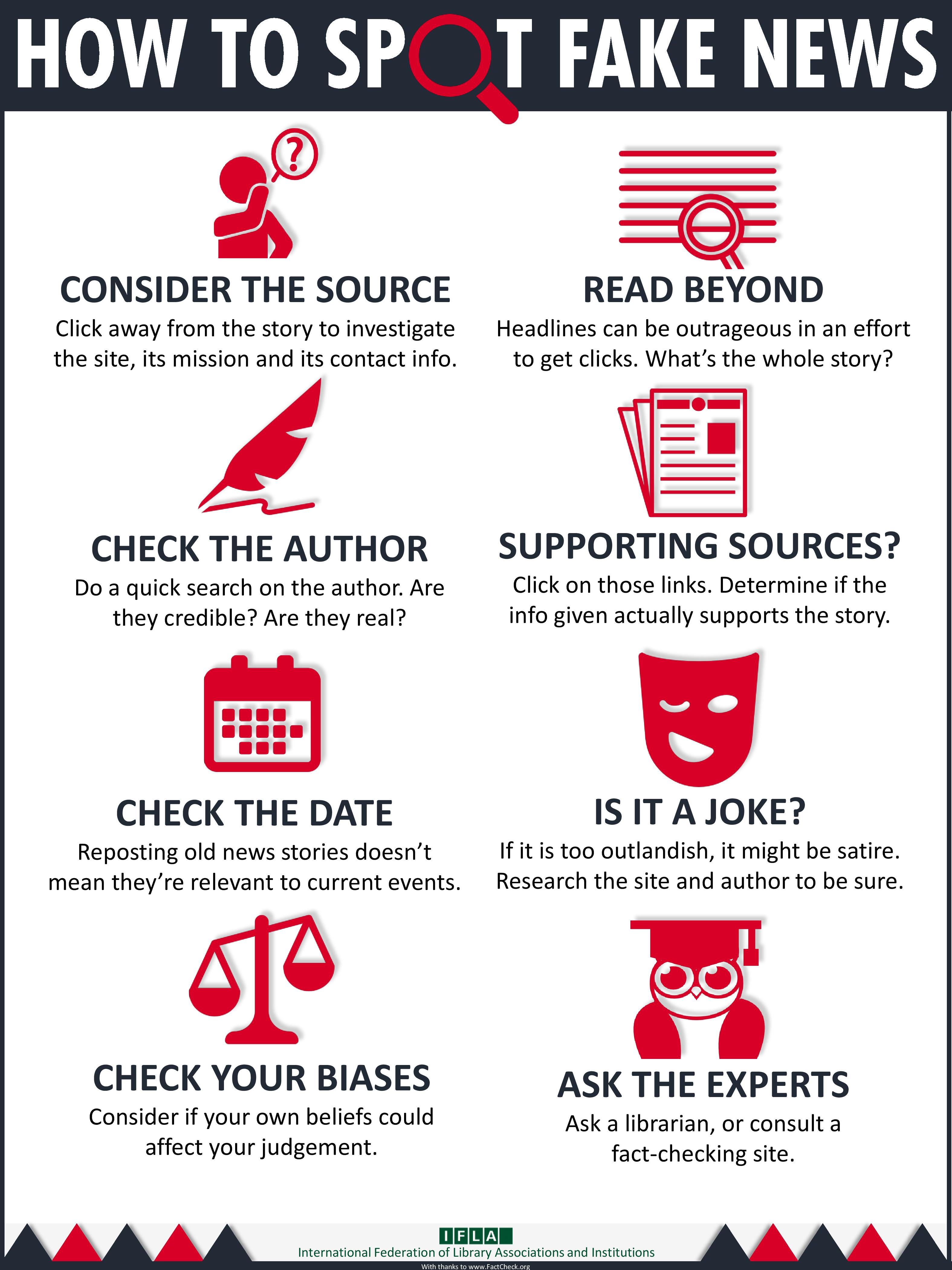
The great (albeit flawed) filmmaker Orson Welles made a documentary about fraud and fakery entitled "F for Fake." Maybe Welles was ahead of his time, because today we have difficulty telling fake news from actual news. We will discuss the graphic posted above.

In response to concerns that it is a leading disseminator of fake news, Facebook has recently implemented modest changes in what you see on your news feed, how to report suspected fake news, and warnings before sharing items. CNET reports.

Questions...

•Why does news have to be grounded in fact? Why not simply have news that is entertaining?

•Why do you think fake news is a bigger problem than it was 20 years ago?

•What are some news sources you trust? Are those news sources always accurate?

•Who is the source of the graphic posted above? What do you think of the source?

•What do you think of Facebook's changes to its news feed?

Labels: , , , , , , ,